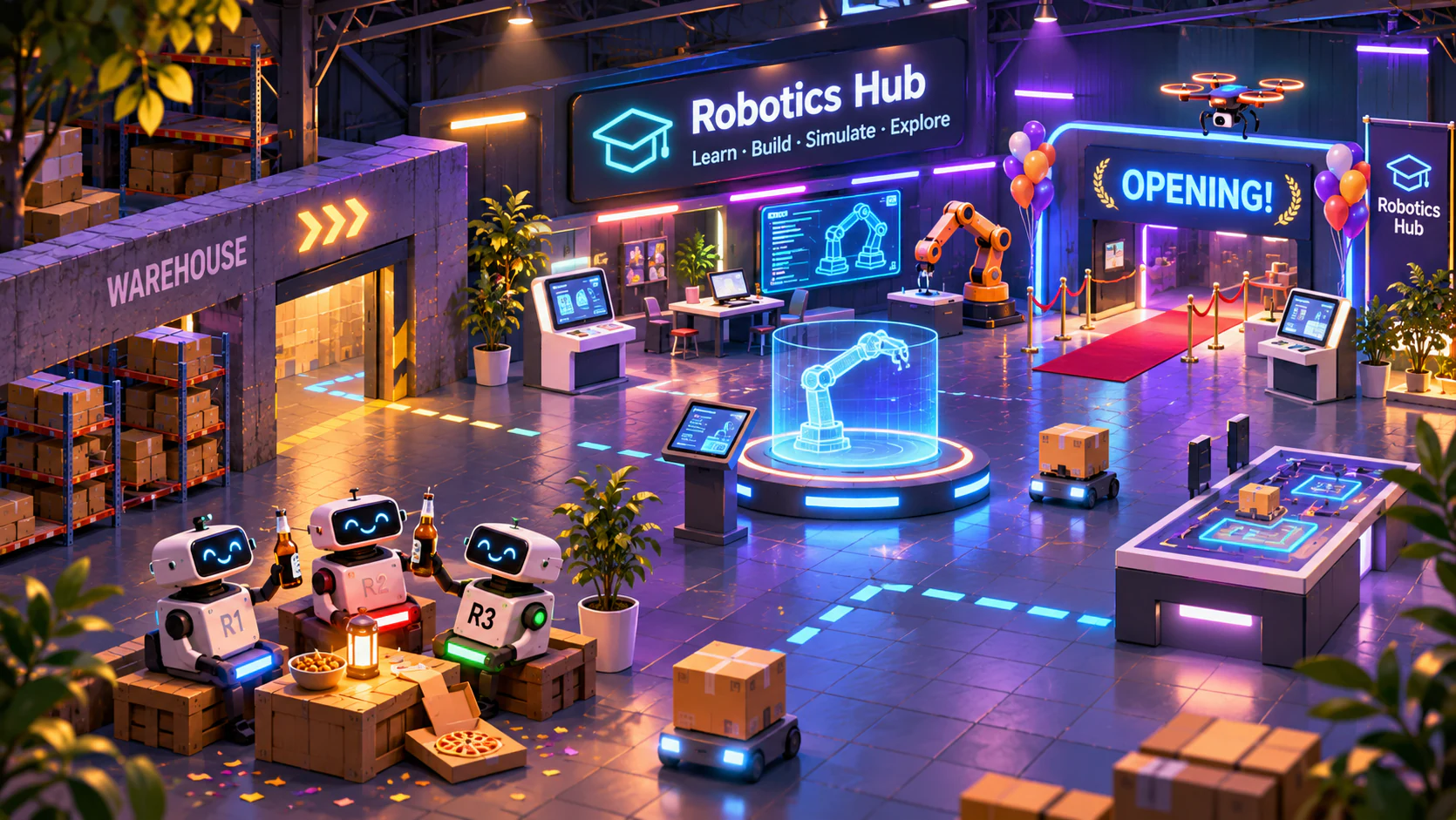
Three Robots Walk Into a Warehouse...
Someone asked if I was an engineer. I had 40 years of gaming experience, access to AI, and apparently no self-control. Less than a week later, a lip-syncing robot was welcoming visitors to my robotics hub.
robotics · artificial-intelligence · simulation · software-engineering · gaming
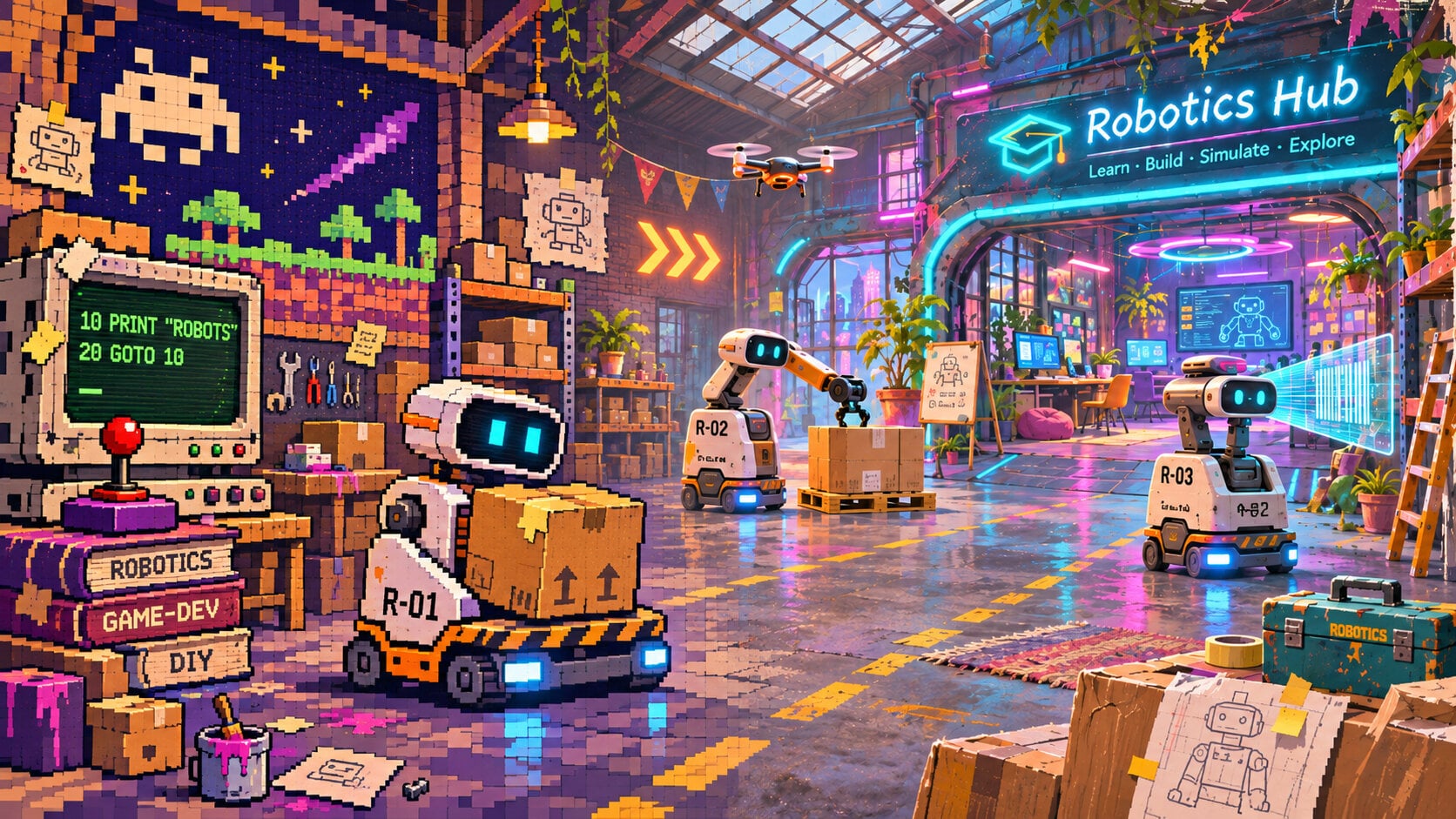
At some point, I started feeling sorry for my robots.
There were three of them, living in a tiny virtual warehouse, moving boxes from shelves to a loading dock. They were surprisingly competent. They planned routes, avoided obstacles, coordinated their movements, and occasionally got into arguments about who had the right of way.
And when they finished their work, I reset the simulation and made them do it all over again.
No salary. No weekends. No career development. Not even a coffee/oil machine.
I'd accidentally built Amazon's dream workforce.
Something had to change. But first, a little history.
Are You an Engineer?
A while ago, through something completely unrelated to robotics, I met an impressive entrepreneur from the world of business and education. She was working on an ambitious AI & Robotics Hub, with international partners, including in China. Real machines, real investment, real plans. Not three rectangles wandering around my laptop.
We got to know each other through education. Somewhere between conversations about how children learn and what technology might do for them, she suggested I might help build the Hub. An interesting offer to make to a man whose principal experience with robots involved science-fiction films and occasionally yelling at a printer.
Then came the question: "Are you an engineer?"
An excellent question. I've spent more than 25 years engineering software, but robotics tends to conjure images of motors, circuit boards, and knowing which end of a soldering iron to hold.
My father is an electrical engineer. His father worked with machines, and his father apparently with cars. The family records get fuzzy there; presumably someone further back was complaining about the quality of the wheel. Different materials, same suspicious tendency to take things apart and insist we can improve them.
Of course I'm an engineer. More importantly, I'm a builder. The interesting question was what my kind of engineering could bring to robotics.
There was only one responsible way to find out: start another project.
A Little History, Starting Around 1985
I've been playing computer games since around 1985, when eight colors were considered impressive graphics and starting a game could mean removing the screen cover, typing a command at a prompt, and trusting the machine not to take your afternoon personally.
I loved the games, but I wanted to know what happened behind the pixels. That curiosity got me writing BASIC and experimenting with 3D modeling before I had a mouse. Modeling with keyboard commands is a great way to develop patience, or whatever the opposite of patience is when you keep doing it anyway.
About 15 years ago, I was building casual games, isometric worlds, animations, and game mechanics. Making little characters move around, follow rules, interact with objects, and occasionally do something completely idiotic was a big part of the fun.
In retrospect, excellent preparation for managing software engineers.
My career eventually evolved through web development, startups, architecture, products, and all the usual ways of turning a perfectly enjoyable hobby into an endless series of meetings.
I never stopped being a gamer. Or reading enough apocalyptic science fiction to find every humanoid robot demo equal parts fascinating and terrifying. Has nobody in those laboratories seen Terminator?
Still, curiosity usually wins.
Robotics Has a Suspiciously Familiar Bug List
I started studying navigation, sensors, fleet coordination, mapping, and autonomous agents. And I kept recognizing things.
State machines? Been there. Pathfinding? Built that. Collision detection? Yep. Scheduling, resource allocation, distributed state, fault recovery? That's practically a normal Tuesday in backend development.
A robot navigating around an obstacle is surprisingly similar to moving a character through a game world. A coordinator assigning tasks to robots resembles a scheduler. Robots working with incomplete information about their environment?
“Congratulations, you've discovered distributed systems, only now the servers have wheels.”
Of course, real robotics adds complications. When a backend service crashes, it doesn't normally fall down a staircase.
I still had a ridiculous amount to learn about motors, control systems, and the small inconvenience of physical reality. But I was surprised by how quickly things clicked. Apparently, decades of building virtual worlds and keeping software systems from collapsing had been useful preparation. It felt a bit like Neo learning to fly a helicopter in The Matrix. Except my brain wasn't receiving a mysterious martial-arts download. It was recognizing old problems wearing new hardware.
And because I'm incapable of studying something interesting without building an unnecessarily elaborate side project, I started a simulation. The whole adventure, from that first dive into robotics to the Hub demo, would take less than a week. Not a full-time week, either. Apparently the trick to moving this fast is twenty-five years of groundwork, AI coding agents, and wildly optimistic time management.
Three Robots Walk Into a Warehouse
The first version was intentionally boring.
A warehouse. Three robots. Five packages. Some shelves. A loading dock.
No fancy graphics, no realistic physics, no robot dogs doing parkour. Just a grid, some rules, and a simulation engine.
Each robot had a state and capabilities. A coordinator assigned deliveries, robots calculated routes, and the simulation advanced in discrete steps called ticks.
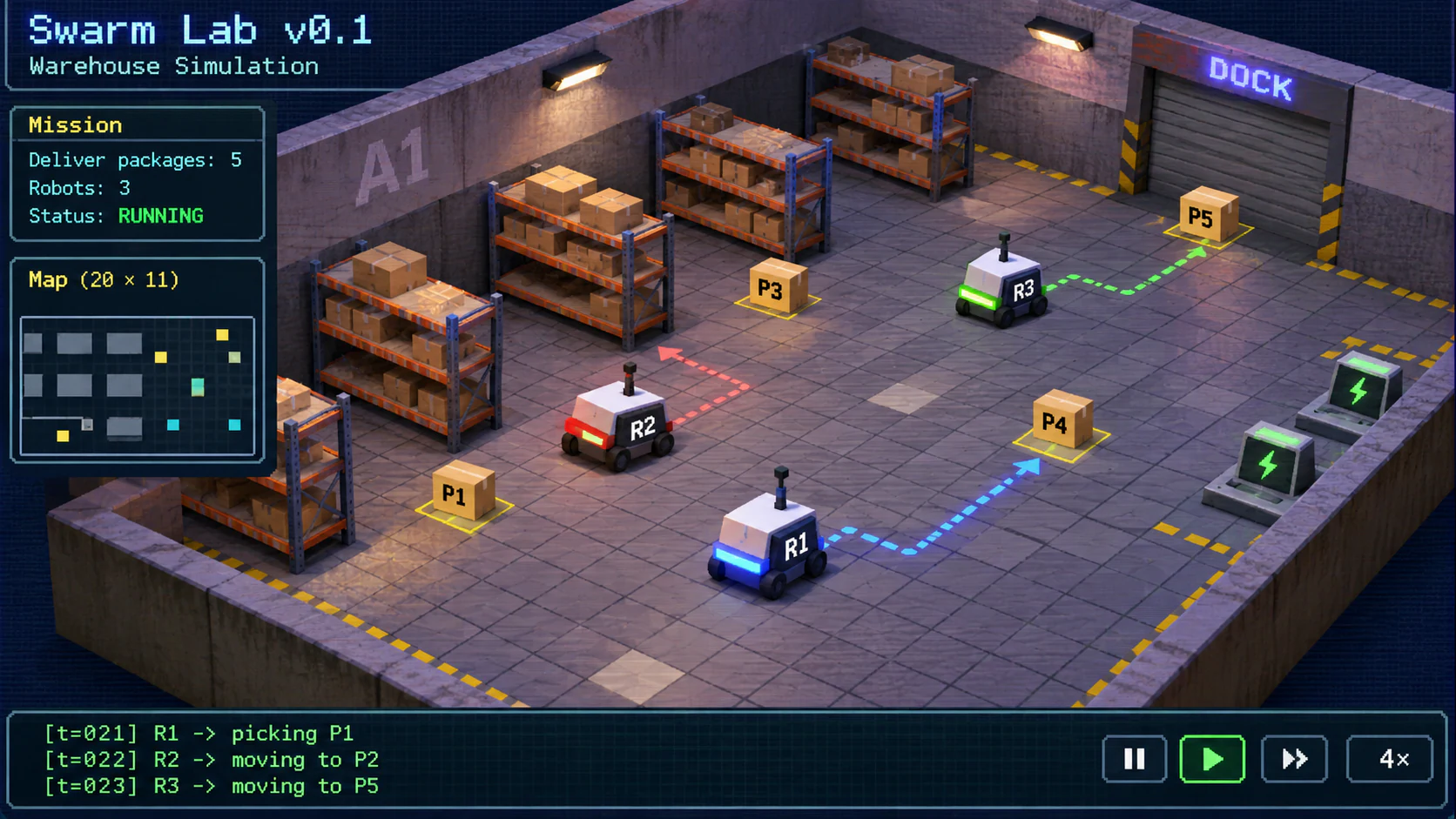
The first successful mission delivered all five packages in 57 ticks.
I was ridiculously happy. Three imaginary employees had achieved a measurable KPI, and I hadn't even needed to schedule a stand-up.
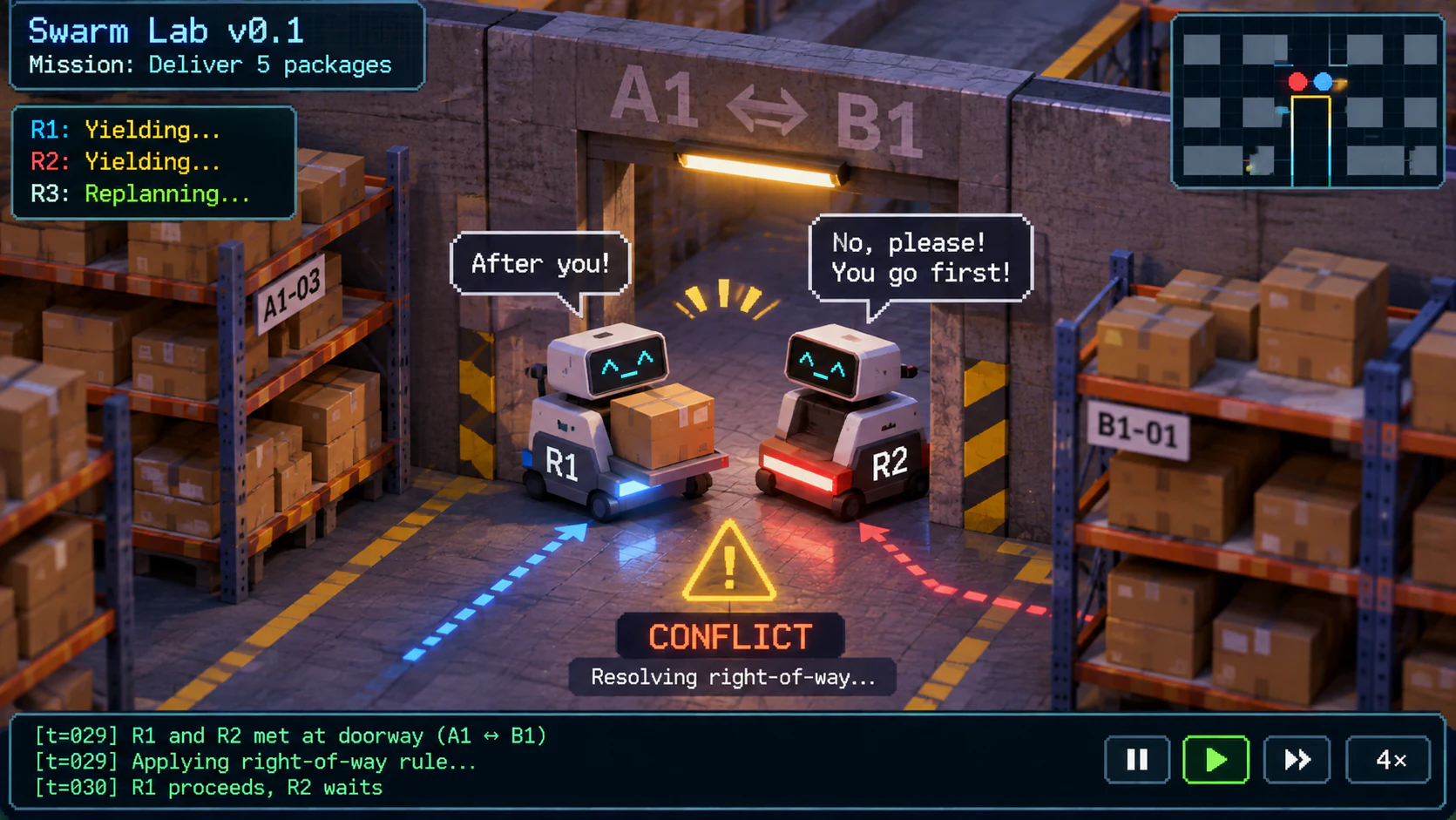
Then two robots tried to enter the same narrow corridor from opposite directions. Both had valid routes, and neither could get through. A classic concurrency problem, except instead of processes competing for a database lock, I had two imaginary robots arguing over a square of imaginary floor.
We gave priority to the robot carrying a package. The other yielded, and off they went. I may have spent an unreasonable amount of time watching this happen.
Naturally, I started deliberately breaking things.
I blocked corridors, cut off the dock, and experimented with battery limits and malfunctions. One robot could get lost or run out of energy trying desperately to satisfy its demanding god and creator, who was sitting behind a laptop drinking coffee and wondering why morale was so low.
One obstacle turned a 57-tick run into 72. Other interventions left robots stranded. Excellent: traffic congestion, workplace exhaustion, and management-induced failure. The enterprise software experience was paying off.
The experiments raised questions about sensing, maps, location awareness, and communication. What if one robot knew a corridor was blocked but the others didn't? Not everything needed implementing immediately; some mechanisms were modeled, others simplified or documented for future experiments.
My Development Team Is Artificially Intelligent. So Is Some of Its Nonsense.
I built Swarm Lab with AI coding agents. That wasn't new to me; I already use them extensively across projects. It's how I work today, though the tools evolve absurdly quickly and occasionally believe they know my product better than I do.
They can generate thousands of lines of code in minutes. Some are excellent. Some are complete nonsense delivered with the confidence of a senior architect explaining why the production outage was technically a feature. The skill isn't making AI write code. It's knowing what should be written, and when to tell an enthusiastic digital colleague to stop inventing infrastructure.
I treated the agents as an engineering team: vision, architectural boundaries, small stories, tests, and reviews. Before implementing an unfamiliar concept, I'd study it, challenge the alternatives, and understand the tradeoffs. Then we'd build one focused piece and verify it.
“Learn, plan, build, test, review, understand, repeat.”
Most importantly, focus on the working task. Leave room for tomorrow without designing tomorrow's entire enterprise before three robots can deliver five boxes.
Give an AI too much freedom and it might decide your three-robot warehouse needs Kubernetes, a blockchain-based inventory system, and a comprehensive enterprise authentication platform.
I exaggerate. Slightly.
AI made experimentation dramatically faster, but I still owned the decisions and understanding. Having it do all the learning while I occasionally pressed Enter would rather defeat the purpose.
A Warehouse, a Hub, and a Terrible Case of Scope Creep
Meanwhile, the real Hub was taking shape, with actual people, actual equipment, and significantly higher shipping costs. I was being sent videos from China of synchronized dancing robots: either the future of education or the opening scene of a very expensive disaster movie.
I joked that while the Hub's founder was busy in meetings, robots should unpack the deliveries and assemble the place. Let the humans supervise. Or at least make coffee.
Maybe not this time. But perhaps in the next Hub.
And then I looked at my own three virtual robots, still endlessly transporting the same five packages.
Why shouldn't they?
Mine had never assembled so much as a stool, but it's a simulation. They were spectacularly unqualified. What could possibly go wrong?
The new mission: keep the warehouse for logistics, and build an educational AI & Robotics Hub next door. The boxes now had a destination that meant something.
Transport robots deliver packages. Scanning robots inspect them. Others unbox equipment, while specialist assembly robots put things together: desks, displays, experimental stations, maybe even flat-pack furniture. A whole new research question: can an autonomous robot assemble a bookshelf without having a small existential crisis halfway through?
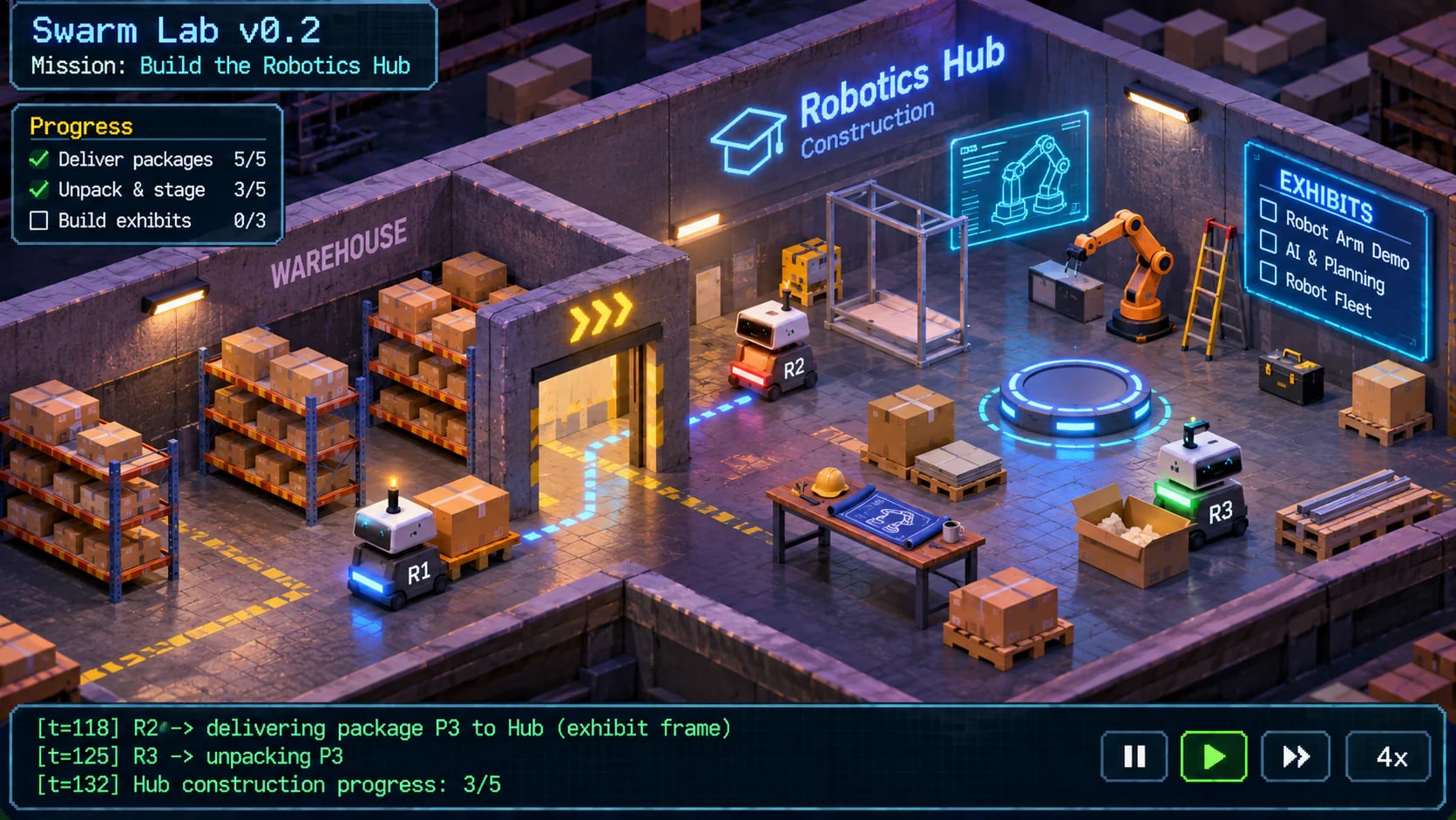
Different capabilities, shared goals, dependent tasks. Simulated assembly isn't the same as making a physical robot operate an Allen key, but at least the work had a visible outcome. With each completed task, furniture appeared, neon lights came on, screens started playing, machines moved, and a drone took flight. The empty Hub became a futuristic educational mall.
We even gave the Hub a robot host to narrate the mission, complete with lip-sync. Forty years of gaming, and I was still trying to make pixels act human. This one had apparently developed a serious need for attention.
“The robots were now building the place where humans could come to learn about robots.”
At this point, the simulation had clearly developed ambitions of its own.
There was one engineering rule underneath the spectacle: no puppet show disguised as robotics. The simulator owns decisions and state; the 3D world displays them. Robots use defined commands, capabilities, and state interfaces. Connecting compatible real robots would largely mean writing the appropriate adapters, not rewriting the mission and coordination logic. The architecture makes that relatively straightforward; getting physical robots to behave safely is another matter. Motors, localization errors, safety checks, and gravity remain stubbornly unimpressed by my TypeScript types.
I'm happy to simplify physics. I'm less interested in faking intelligence. So there's an Exhibit for visitors and an Engineering Lab to inspect what actually happened: paths, decisions, failures, the lot. Think SimCity meets Factorio meets a robotics lab, with occasional moments of The Office.
I Built the Course While Taking It. Naturally.
Learning was part of the job, not a side effect. Whenever I explored a robotics concept, the AI workflow helped turn it into a proper learning topic: plain-English explanation, technical details, examples, exercises, references, and links to the code. Before long, I had a browsable robotics learning website. Apparently I couldn't just take a course; I had to build the school while attending it.
I wanted it to suit curious brains, including those with ADHD: quick explanations when you need them, deep dives when you want them, and rabbit holes without a professor demanding you return to slide 47. It also covered concepts we hadn't implemented, such as real sensors, localization, mapping, and hardware, while being clear about what the simulator only assumed.
One minute I was a robotics student, the next a game developer or a product manager, then reviewing AI-generated tests. A fairly normal afternoon for someone who apparently doesn't believe in having one hobby at a time.
Mission Complete. No Sequel Required.
Less than a week, part-time, and an absurd number of rabbit holes later, the robots had built their Hub. I'd built something I could understand, experiment with, and show other people. Not bad for a question that started with "Are you an engineer?"
A word of thanks, though. To people with big ideas who invite others into them, ask the sort of questions that send you off learning, and remind you why building things is fun. And to the people I love, who patiently gave me room to spend an alarming amount of time managing three imaginary employees. You're the reason this kind of adventure is possible. I promise the robots didn't get all my attention.
I'm still reading the learning site and exploring new ideas. I just don't need to convert every interesting thought into another feature and a roadmap for the next seventeen quarters. Curiosity can go deeper or move on; it doesn't owe a project a lifetime subscription.
Somewhere on my laptop, the Hub lights up, a drone takes off, and a robot host delivers the grand-opening speech with suspiciously enthusiastic lip-sync.
The workforce has earned a break. I'm sure they'll appreciate it once I stop pressing Reset.
I've got other things to build.