


Hi, I'm Sagi.
I turn ideas, problems and opportunities into practical technology.
I work with founders, business owners and teams to refine what they want to achieve, make good technical decisions, and get useful things built and shipped.
I've spent more than 25 years building products, leading technology and working hands-on — and I work best close to the actual problem.
Founder · engineer · technical leader · builder
On my mind.
I'm usually learning, building or experimenting with something.
Things I'm testing, noticing, fixing, learning, questioning and occasionally overthinking.
Knowing when to shut up
Voice AI is getting a second model to manage the conversation while the main LLM works on the answer. Speak? Wait? Let the person finish? Deepgram's Think-Live handles that side. Because "great" sounds very different when you've fixed someone's problem and when you've charged them twice. Deepgram's examples with Jev take this further. One voice-controlled music project was spending most of its response time asking Claude which tool to call. A dedicated classifier now routes commands separately. "Stop the music" probably doesn't need a thinking partner. It needs the music to stop. I can see this becoming common in support, education and the machines around us. Different models handle listening, decisions and replies, while code controls when to act or ask for clarification. We could spend less effort explaining ourselves and still get understood. Which sounds great until I imagine the Idiocracy version: the machines get so good at understanding us that we stop making much of an effort. Three words, a grunt, fridge opens. Finally, all that language evolution paying off. :))
Three robots. One doorway.
Working on robotics. Three robots can plan routes and avoid obstacles, but put two at the same doorway and suddenly it's "After you." "No, please." Both move. Both stop. "Sorry." "No, my fault." FOR F***'S SAKE, SOMEONE GO. The fix was forcing one to step aside and stay there while the other passed. All that engineering to teach a robot when to stop being such a gentleman.
Please break the demo
Building an interactive robotics demo, which means preparing for the most unpredictable thing in the room: the visitors. The robots have rules. Visitors will press something halfway through your explanation, then press it again because nothing exploded. Honestly, that's the part I'm looking forward to. Block a route, disable a robot, interrupt the plan. I want to see the others adapt. You can spend days inventing test scenarios. Or let someone near the buttons.
Browse the journal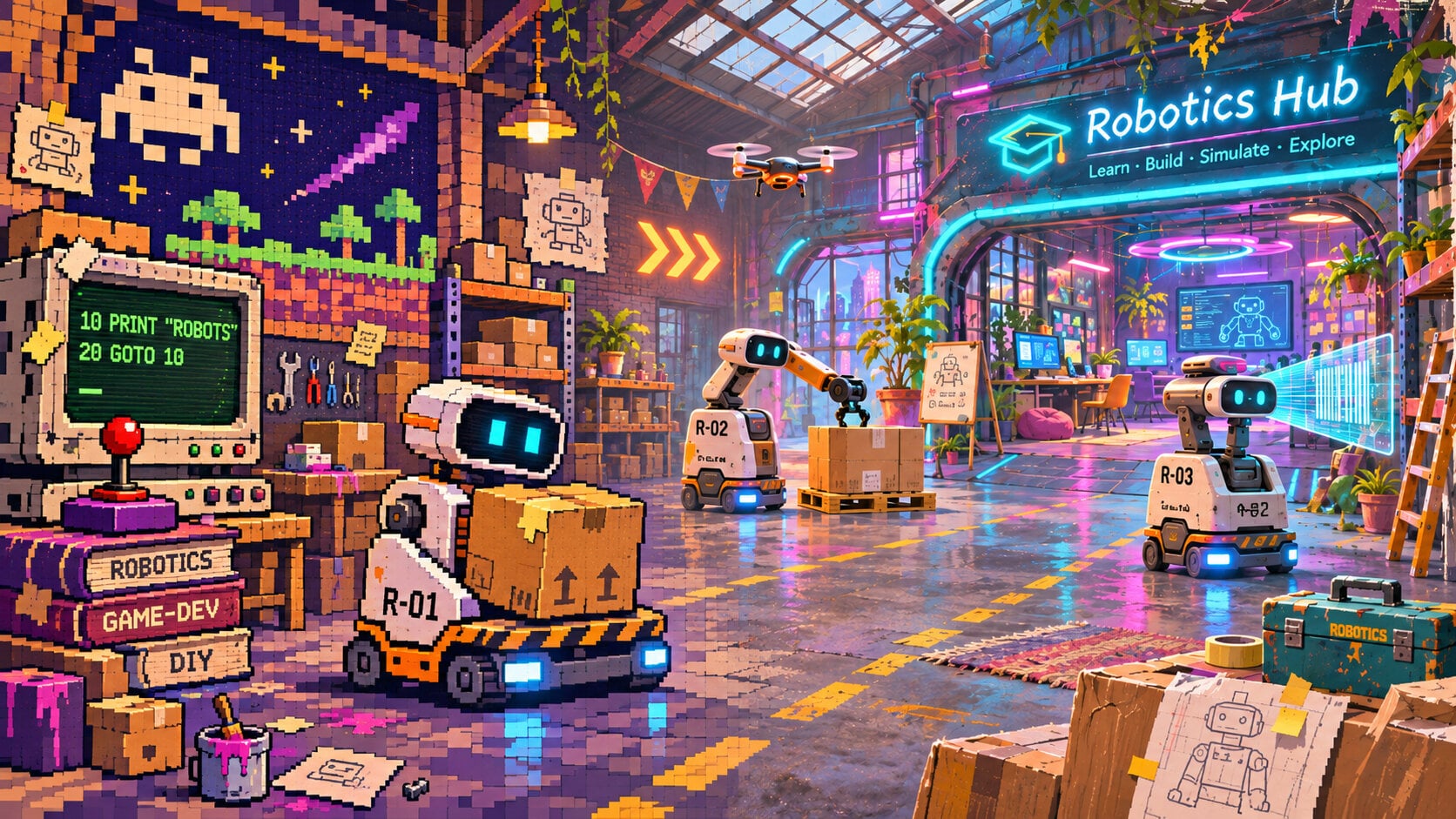
From the workbench
Three Robots Walk Into a Warehouse...
Someone asked if I was an engineer. I had 40 years of gaming experience, access to AI, and apparently no self-control. Less than a week later, a lip-syncing robot was welcoming visitors to my robotics hub.


Where I'm useful
Technology is a toolbox. The problem decides what we use.
Products & technical decisions
Ideas, existing products, architecture, technical plans, vendors, estimates and difficult decisions about what to do next.
Review · Direction · Technical leadership
AI & automation
Use AI where it actually helps: reduce repetitive work, connect information, improve services and build workflows that are useful beyond the demo.
AI · Automation · Internal tools
Build & ship
Turn the plan into something real - from a quick prototype to a production product.
I can build directly, work with your team, or help bring the right people together.
Prototype · Product · Delivery
Teams & people
Technology is built by people.
I can lead, mentor, help structure technical work, interview or hire, facilitate technical discussions, and work as part of the team rather than above it.
Leadership · Mentoring · Workshops · Teaching
About me
Experience compounds.

Sagi Chizik
I started as a developer and gradually became responsible for larger parts of the picture - products, architecture, teams, delivery, companies and the decisions connecting all of them.
Over more than 25 years, I've worked across startups and larger companies, led engineering organizations, served as CTO, built products from zero and stayed close to the actual work.
Today I'm a founder and builder based in Bucharest.
I co-founded TipMaster and helped take it from an idea to a real product in production. Earlier chapters include Wix and many products, teams and experiments that shaped how I think today.
The more I learn, the more interesting the problems become.
LinkedIn →A good place to start
Bring me something you want another pair of eyes on.
A product. A process. An AI implementation. A technical plan. A workflow. A vendor proposal. An idea you're about to invest in.
I'll understand what you're trying to accomplish, look at what exists, and give you my view of the best way forward.
UNDERSTAND
What exists, what matters and what you're actually trying to achieve.
EVALUATE
What works, what doesn't, what is risky, and where the opportunity is.
RECOMMEND
What I would do, what I wouldn't, and what I'd do first.
Sometimes that's enough. Sometimes it becomes the beginning of working together.
Ask me to look at something →

The lab
I'm almost always building something.
Some things become products. Some become tools. Some are experiments. Some exist because I wanted to know if they could.
Swarm Lab
Robotics simulation / multi-agent systems
A software-only simulation of autonomous warehouse robots: route planning, task coordination, obstacles, failures and one very polite doorway dispute. It started as a way to learn robotics and ended with the robots building a robotics hub.
Read the story →Max
AI assistant
I wanted a better way for visitors to explore my work than another contact form, so I built Max - an AI assistant that knows the site, asks useful questions, and helps people figure out whether there's something worth discussing.
TipMaster
I co-founded TipMaster and helped take it from an idea to a real product in production.
Nori
Cross-platform app / Kotlin Multiplatform
A cross-platform product experiment built around a shared Kotlin Multiplatform core - keeping the important logic in one place while letting each platform still feel native.
Music Mission
Music analysis / games
A small library for understanding the structure of music - rhythm, sections, timing, and useful events - so I can build games and other experiments on top of it.
This website
Three.js, AI, design, writing and a place to experiment in public.
Curiosity has caused a lot of unnecessary work over the years. I'm keeping it.
A few things I believe.
- Understand before prescribing.
- Tell the truth, even when it's inconvenient.
- Prefer the simplest useful solution.
- The goal isn't more technology. It's a better result.
- Good work is a team sport.
Come say hello
Have something you want to make better?
You probably already have an idea of where you want to go.
Tell me about the business, product, problem or opportunity. I'll listen, ask questions and see whether I can add something useful.
If it makes sense, we'll take it from there.
Want to explore first? .
Already know you want to work together? Say that too.